What and Why
Muons are secondary particles created by nature's particle collider: high-energy cosmic rays colliding with protons and neutrons in the upper atmosphere, breaking them into subatomic particles. Muons carry an electric charge identical to an electron or positron but with 200 times the mass.
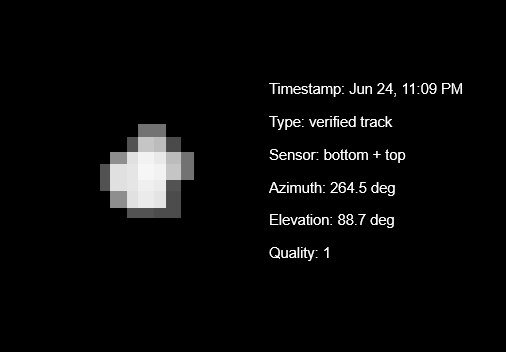
As these heavy, charged particles pass through a silicon sensor at 99.9% the speed of light, they frees electrons from silicon atoms along the path, generating a hit on the camera.
A small home particle detector can log a record of muon hit patterns, directions, and rates correlated with atmospheric and cosmic events. While we know many cosmic rays originate from solar flares and supernovae, the ultimate sources of the most energetic cosmic rays remain a mystery. Engaging in low-cost, distributed data collection helps bridge the gap in our understanding of these deep-space accelerators.
The Visualization
Each line is a reconstructed local direction from a verified event detected by MINT. Specifically, paired hits within tight tolerances on stacked cameras are promoted to verified track candidates, strongly suppressing noise and other anomalous events.
My current configuration has a 0.038% per-event chance of producing a false positive. View the MINT source code on GitHub.
The visualization plots verified-track candidate rays using azimuth, elevation, timestamp, and quality score. Solid segments run between the detector and atmosphere; faint extensions preserve the reconstructed direction vector. The event log below includes the full real detector feed.
About the MINT Detector
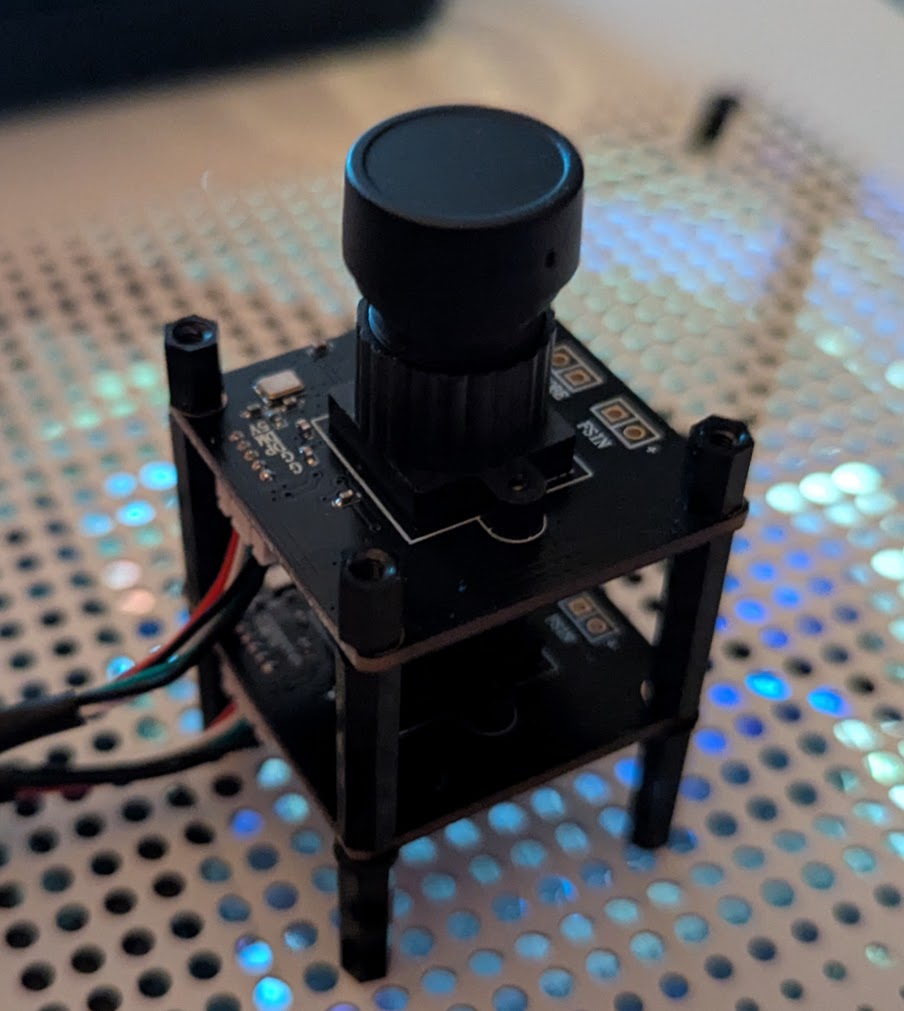
MINT is a buildable home-lab muon detector using two inexpensive camera sensors in a stacked verification setup. The target bill of materials is about $70 to $100, making particle detection approachable without lab-grade hardware. Build one from the MINT GitHub guide.
Event Log
Detector Events
Live Telemetry
Current Detector Run
| Timestamp | Type | Sensor | Azimuth | Elevation | Quality | Frame Delta |
|---|